

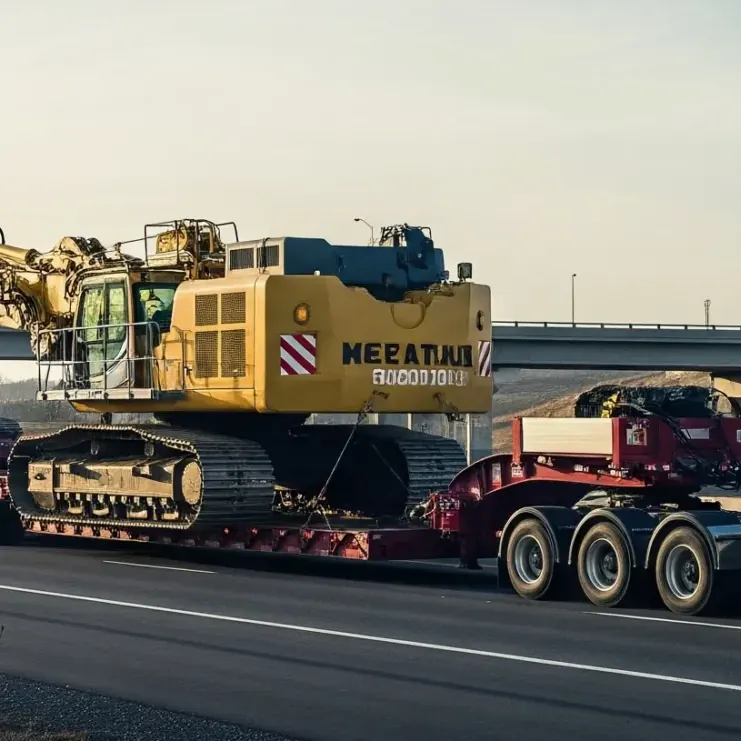
West Virginia Oversize & Overweight Permits for Heavy Haul
West Virginia permit rules, legal limits and escort triggers, and how we book heavy haul carriers for moves in and through the state.
Quick answer
Do I need a permit to move an oversize load in West Virginia?
Yes, once a load is wider than 8 ft 6 in, taller than 13 ft 6 in or heavier than 80,000 lbs. WVDOH's Central Permit Section issues permits through wv.gotpermits.com: $20 for a single trip, plus 4 cents per ton-mile on overweight loads. Oversize loads move from sunrise to sunset only, and loads over 14 ft wide stay off the road on weekends.
Updated November 2026 by the Quickway Transports broker team (FMCSA MC# 1245224).
Heavy haul and oversize freight in West Virginia
West Virginia's heavy freight follows I-64 and I-77 through Charleston, I-79 north through Clarksburg and Morgantown toward Pittsburgh, I-81 across the Eastern Panhandle and I-70 through Wheeling. Mining and gas equipment, plant machinery in the Kanawha Valley and loads crossing between Ohio, Pennsylvania and Virginia make up much of the oversize traffic. Quickway lines up carriers for West Virginia moves and for loads passing through its mountains.
Terrain and timing drive West Virginia quotes. Oversize loads run only from sunrise to sunset, Charleston and school bus hours trim the day further, and the West Virginia Turnpike climbs from about 600 ft to over 3,400 ft at Flat Top Mountain with its own height and width limits. Bridges that pass a load only at reduced speed need a WVDOH permit monitor booked ahead of the move.
What are the legal size and weight limits in West Virginia?
Under the oversize load regulations in West Virginia, a load above any of these limits needs a state oversize or overweight permit.
| Width | 8 ft 6 in |
|---|---|
| Height | 13 ft 6 in |
| Semitrailer length | 53 ft |
| Gross weight | 80,000 lbs |
| Single axle | 20,000 lbs |
| Tandem axle | 34,000 lbs |
Limits come from W. Va. Code 17C-17. The 8 ft 6 in width applies on designated highways and roads with lanes at least 10 ft wide; narrower local roads hold 8 ft. US and WV routes allow 80,000 lbs with a 10% tolerance, local service routes stop at 65,000 lbs, and the Interstate allows no tolerance.
Who issues West Virginia oversize permits?
WVDOH's Central Permit Section in Charleston issues permits online through wv.gotpermits.com, which runs route, bridge and clearance checks automatically and lets most carriers self-issue in minutes. Phone applications are not accepted; the office answers questions from 7:30 AM to 4 PM, Monday to Friday, and a manual review normally takes up to 24 hours.
A single-trip permit is valid for 5 days and reaches 16 ft wide on four-lane roads (15 ft on two-lane roads), 120,000 lbs gross and 28,000 lbs on a single axle, with height and length set by what the route can take. Anything bigger is a superload, which takes 48 hours or more and may require bridge work at the applicant's expense, and a move through more than one WVDOH district needs each district's approval.
Permit system: wv.gotpermits.com
What do West Virginia oversize and overweight permits cost?
- request_quote Single trip, oversize, overweight or both: $20, plus 4 cents per ton-mile for overweight.
- request_quote Superloads: the same $20 single-trip fee; applications not activated within 30 days may be charged $20.
- request_quote Annual permits: $200 for oversize only, $500 for oversize and overweight.
- request_quote Low-impact bridge monitoring: $150 for one bridge, $250 for two, then $50 more per bridge, capped at $750.
- request_quote West Virginia Turnpike tolls for oversize trucks (class 10): $27 cash or $21.60 with a West Virginia E-ZPass at each mainline plaza.
Worked example: a 13 ft wide dozer with the blade on
At 13 ft wide the load needs front and rear escorts on two-lane highways and one rear escort on four-lane roads. Loads 14 ft wide or less can run on Saturdays and Sundays if the application asks for it, though not on the Turnpike, and still only between sunrise and sunset. The dozer can keep its blade on, angled away from oncoming traffic, because the load stays at 14 ft or less.
West Virginia pilot car and escort requirements
- local_police 10 ft 6 in to 12 ft wide: a front escort on two-lane highways, none on four-lane roads.
- local_police 12 ft 1 in to 14 ft: front and rear escorts on two-lane highways, a rear escort on four-lane roads.
- local_police 14 ft 1 in to 15 ft: front and rear escorts on every road, Monday to Friday only.
- local_police 15 ft 1 in to 16 ft: two front and one rear on two-lane roads, one front and two rear on four-lane non-Interstate highways, and two rear on the Interstate.
- local_police Over 15 ft high: a front pole car. Length 75 to 95 ft on two-lane roads: a rear escort; over 100 ft: front and rear on every road.
- local_police Escort vehicles need an amber rotating or strobe light and a 60 in by 12 in yellow OVERSIZE LOAD sign, and for-hire escorts also carry a radio to the load, a STOP/SLOW paddle and fire extinguishers.
What hours can oversize loads move in West Virginia?
- calendar_today Oversize loads: sunrise to sunset only. Overweight-only loads up to 110,000 lbs can get night travel on designated multi-lane highways.
- calendar_today Weekends: loads up to 14 ft wide may travel if the application asks, except on the Turnpike or with bridge monitoring; 14 ft 1 in to 16 ft move on weekdays, and anything over 16 ft is limited to Sunday before noon.
- calendar_today WVDOH's holiday list stops travel on six days: Christmas, Thanksgiving, Labor Day, the Fourth of July, Memorial Day and New Year's Day. The rule also reaches holiday weekends and other state legal holidays, so the permit face governs.
- calendar_today Charleston area, escorted loads: no travel 7 to 9 AM and 4 to 6 PM during daylight saving time, and only 9 AM to 4 PM during Eastern Standard Time.
- calendar_today School year: escorted loads stay off two-lane highways from 7 to 9 AM and 2:30 to 4 PM on weekdays, and event closures include WVU home football days around Morgantown and Bridge Day on US 19.
Seasonal weight limits in West Virginia
West Virginia has no fixed frost-law season. Counties and cities can restrict or close a road for at most 90 days in a calendar year if weather or thaw would damage it, and WVDOH can do the same on state highways by Commissioner's order, effective once signs go up at each end. Overweight permits are generally not issued over routes under those limits, so a winter or spring move gets a route check first.
West Virginia Oversize Load Questions
Permits, escorts and travel rules for oversize moves in West Virginia.
How much does a West Virginia oversize permit cost?
Can oversize loads use the West Virginia Turnpike?
Can oversize loads travel on weekends in West Virginia?
Can oversize loads go through the Wheeling Tunnel?
Do bulldozers have to remove the blade in West Virginia?
Sources
We last checked the figures above against these official sources in October 2026. Before each move, the carrier's permit service confirms the rules in force that day.
- WVDOH Oversize/Overweight Hauling Permits page (contact, weekend rule, low impact, document links)
- WVDOH Permit Types (fees, blanket limits)
- WVDOH Legal Size and Weight Limits
- WVDOH FAQ: Hauling Permits (night travel, processing, amendments)
- WVDOH Permit Information sheet (rev. 3-17-2023): limits, fees, travel, escort table, escort equipment, fines
- WVDOH High Travel Days, Events and Other Restrictions (dated 1/1/2024)
- WVDOH Weight and Clearance Restrictions (2017 file)
- WVDOH Policy DOH 2.14 Special Hauling Permits (rev. 02/08/2023)
- W. Va. Code Chapter 17C, Article 17 (Size, Weight and Load), full-article PDF
- W. Va. Code 17C-17-12 Restricting use of highways
- WV Parkways Authority toll rates (class 10 oversize trucks)
- WV Parkways Authority: Get to Know the Turnpike
- Virginia DMV Form MP 227 (rev. 08/14/2026): I-77 Big Walker and East River Mountain Tunnels
Get a Quote
Heavy Haul Solutions for Oversized and Specialized Loads
Near West Virginia: states and services
- Heavy Haul in Ohio →Oversize moves in and through Ohio: Columbus, Cleveland, Cincinnati and the OH permit rules.
- Heavy Haul in Pennsylvania →Oversize moves in and through Pennsylvania: Philadelphia, Pittsburgh, Allentown and the PA permit rules.
- Heavy Haul in Virginia →Oversize moves in and through Virginia: Virginia Beach, Norfolk, Richmond and the VA permit rules.
- Heavy Haul in Maryland →Oversize moves in and through Maryland: Baltimore, Frederick, Hagerstown and the MD permit rules.
- Heavy Equipment Transport →Which trailer, permits and preparation each kind of construction, farm, mining and industrial machine needs.
- Heavy Haul Trucking →Oversize and overweight loads on RGN, step-deck and flatbed trailers, with permits, pilot cars and route surveys arranged.