

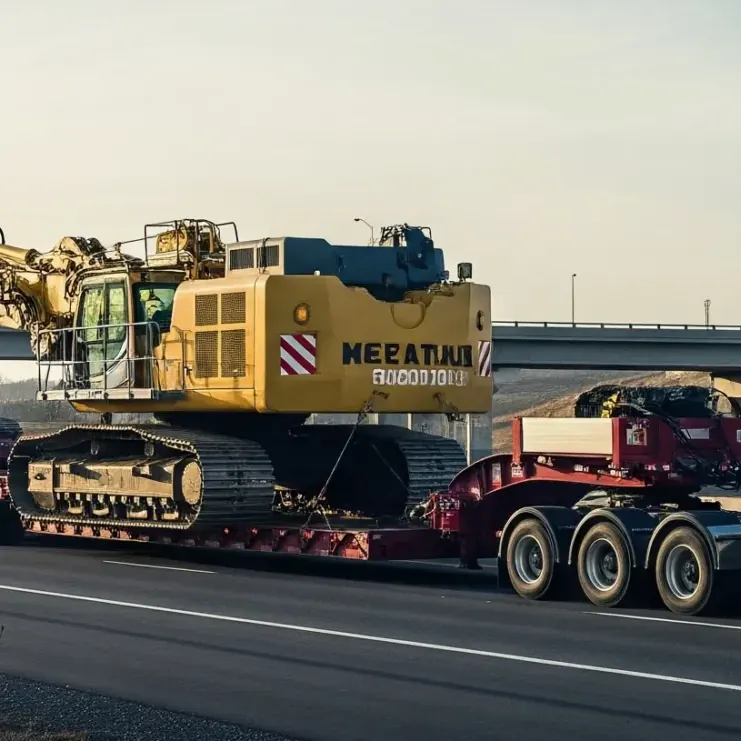
Heavy Equipment Transport
Construction, farm, mining and industrial machines matched to the right trailer, with permits and escorts arranged
Quick answer
How is heavy equipment transported?
Heavy equipment is driven or winched onto a flatbed, step-deck or RGN trailer, picked so the machine stays under the state height limit of 13 ft 6 in to 14 ft. Anything over 8 ft 6 in wide or 80,000 lbs gross needs a permit in each state on the route, and wide loads often need pilot cars. Taking off attachments can keep a machine legal.
Updated November 2026 by the Quickway Transports broker team (FMCSA MC# 1245224).
What decides how a machine moves
Three numbers decide almost every heavy equipment move: the machine's transport height, its width, and its weight on the trailer. Federal rules cap width at 8 ft 6 in on the Interstate system and gross weight at 80,000 lbs, and most states set the legal height at 13 ft 6 in or 14 ft. A machine that fits inside all three moves as an ordinary load. One that goes over any of them needs an oversize or overweight permit in every state on the route.
As a broker, Quickway books a carrier whose trailer keeps the load as low and light as possible, then coordinates the permits, pilot cars and route with that carrier. Removing a bucket, blade or counterweight can be the difference between a legal load and a permitted one, so we ask about attachments before we price.
local_shipping Get a QuoteWhich trailer for which machine
Deck height sets how tall the machine can be before the load needs a height permit. These are typical figures; the carrier's exact trailer model can change them by a few inches.
| Trailer | Typical deck height | Freight height under 13 ft 6 in | Common machines |
|---|---|---|---|
| Flatbed | about 5 ft | up to about 8 ft 6 in | Skid steers, compact track loaders, small dozers, forklifts |
| Step deck (drop deck) | about 3 ft 2 in to 3 ft 6 in | up to about 10 ft | Tractors, telehandlers, mid-size wheel loaders, generators |
| RGN / lowboy | about 1 ft 6 in to 2 ft | up to about 11 ft 6 in | Excavators, large dozers, cranes, combines, haul trucks in pieces |
Over 8 ft 6 in wide or 80,000 lbs gross, the load needs an oversize or overweight permit whatever the trailer.
Trailer details: Flatbed transport, Step-deck transport, RGN and lowboy transport.
Transport by machine type
- Excavator Transport →RGN and lowboy moves for excavators, and which buckets, thumbs and counterweights come off before loading.
- Bulldozer Transport →Dozer moves from compact crawlers to mining-class machines like the Cat D11, with blade and ripper removal.
- Crane Transport →Cranes moved in travel configuration or broken down into several loads, with superload permits where needed.
- Mining Equipment Transport →Haul trucks, loaders, drills and crushers, often shipped in pieces under superload permits to remote sites.
- Agricultural Equipment Transport →Combines, wide planters, sprayers and tractors, with header removal and harvest-season timing.
- Machinery Transport →CNC machines, presses, generators and plant relocations on flatbed, step-deck or RGN trailers.
- Commercial Truck Transport →Semi trucks, dump trucks, buses and non-running units, including winch loading for dead units.
- Wind Turbine Transport →Blades, nacelles and tower sections on specialized trailers, with route surveys and superload permits.
- Transformer & Generator Transport →Distribution transformers up to large power units, with superload permits, route surveys and bridge reviews.
What we need to price a machine
- check_circle Make, model and year, for example a Cat 336 excavator or a John Deere S780 combine
- check_circle Operating weight, and the weight of any attachment that ships with it
- check_circle Transport length, width and height in feet and inches, with the boom, header or blade in transport position
- check_circle Attachments that can come off: buckets, thumbs, blades, rippers, counterweights, headers
- check_circle Pickup and delivery addresses, and whether each site has a loading dock, ramp or crane
- check_circle Whether the machine runs and can drive onto the trailer, or has to be winched or lifted
- check_circle The earliest pickup date and the date it has to arrive
Heavy Equipment Transport Questions
Answers for contractors, dealers, farms and plant managers moving a machine.
When does heavy equipment need an oversize permit?
RGN or lowboy: which one does my machine need?
Should I remove the bucket or blade before transport?
Can you move equipment that does not run?
How is heavy equipment transport priced?
Sources
We last checked the figures above against these official sources in November 2026. Before each move, the carrier's permit service confirms the rules in force that day.
Get a Heavy Equipment Transport Quote
Free heavy equipment transport quote
Send the machine's model, weight and transport dimensions with both addresses. We come back with the trailer we recommend, the permits the route needs and a price.
Keep reading
- Heavy Haul Trucking →Oversize and overweight loads on RGN, step-deck and flatbed trailers, with permits, pilot cars and route surveys arranged.
- RGN Transport →Removable gooseneck and lowboy trailers for machines that drive on, from mid-size excavators to mining dozers.
- Step-Deck Transport →Drop-deck trailers for freight up to about 10 ft tall that would be over height on a standard flatbed.
- Excavator Transport →RGN and lowboy moves for excavators, and which buckets, thumbs and counterweights come off before loading.
- Bulldozer Transport →Dozer moves from compact crawlers to mining-class machines like the Cat D11, with blade and ripper removal.
- Crane Transport →Cranes moved in travel configuration or broken down into several loads, with superload permits where needed.